Focused Light: Why Contrast Matters More Than Uniformity
Sound familiar? A room is perfectly lit – uniform, code-compliant, technically flawless. And yet it feels somehow... dull.
The reason: Uniformity is the enemy of drama.
In our episode of "Fun with Relux," we took a deep dive into focused light – the deliberate use of light to highlight objects, create accents, and make spaces truly experiential. Whether it's retail, a museum, an art gallery, or facade lighting: focused light plays by different rules than standard workplace illumination according to EN 12464.
Contrast Is the Goal – Not the Problem
In standard lighting design, we're taught: uniformity is good. High uniformity is the target.
In accent lighting, the opposite is true: the higher the contrast, the stronger the impact. There's no DIN or EN value to comply with here – what matters is the visual impression. The question isn't "How many lux?" but "How does it feel?"
What Shadows Actually Do
A deliberately placed shadow isn't a problem – it's a design tool.
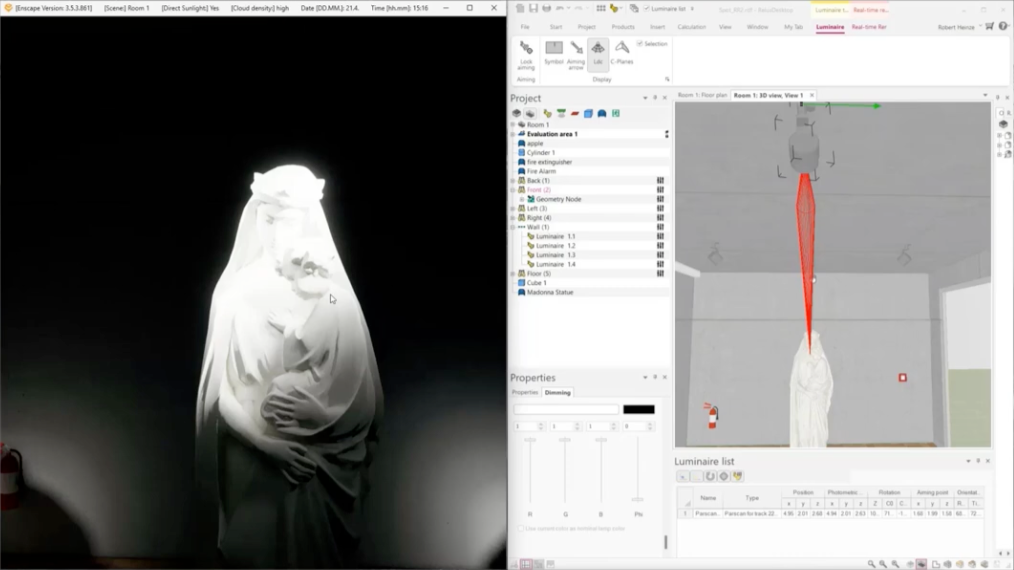
Shadows create depth. They make flat objects three-dimensional, give sculptures volume, and guide the viewer's eye. Working with small, tightly focused light sources (e.g. 2° spots) produces hard shadows – and with them, maximum plasticity.
If you want to reduce shadows, combine multiple light directions. Side, front, and back lighting overlap and counteract each other. At the same time, the object loses some of its three-dimensional quality – a conscious trade-off worth making intentionally.
Direction Defines the Effect
Light from the front: clear, direct, high contrast – but flat. Light from the side: three-dimensional, sculptural, alive. Light from behind: mysterious, contour-defining – great as a complement. Light from below: unnatural, dramatic – use sparingly.
The best results almost always come from combining multiple directions – with individually tuned dimming levels, ideally adjusted on site.
The Sun Always Wins
A key point for outdoor lighting: daylight and focused lighting are practically incompatible. The sun is simply the most powerful light source there is – no artificial system can compete with it.
Focused outdoor lighting only comes into its own at dusk or at night. Anyone wanting to create daytime accents needs a consistent strategy for blocking natural light.
Facades & Outdoor Objects: Relux in Practice
As the highlight of our episode, we showcased a real-world planning project: the outdoor illumination of Neuschwanstein Castle, designed by engineering firm Bamberger. The model – built entirely in Relux Desktop – demonstrates impressively how focused floodlights and spotlights can stage a complex building.

The same principles that apply indoors apply outdoors – with one additional consideration: light emissions and dark sky requirements. Obtrusive light is a serious topic that must be factored into every facade lighting project.
Tools in Relux Desktop
For everyone who wants to plan focused lighting themselves:
- Aiming Tool: Align luminaires directly to target points – with a single click in the 3D model
- Real-Time Rendering: Instant visual feedback on contrast, shadows, and overall effect
- Mirror Groups: Ideal for symmetrical facade and outdoor lighting layouts
- False Color Display: Quick overview of illuminance levels and distribution
Curious to try it yourself? The sample files from this episode are available directly in Relux Desktop: go to Help → Sample Projects.
Full Fun with Relux episode here
Download ReluxDesktop
Update or download to the latest ReluxDesktop version to take advantage of the latest features such as ReluxSport.Download