GLDF: How RELUX and DIAL Are Uniting the Lighting Industry with an Open Data Format
A single, uniform data format for the entire lighting industry – that was the goal when RELUX and DIAL announced their joint development of the Global Lighting Data Format (GLDF) in 2019. Today, GLDF is an open, free standard that combines photometric data, BIM, 3D models, and commercial information in a single file. This article tells the full story – including why two competitors decided to build it together.
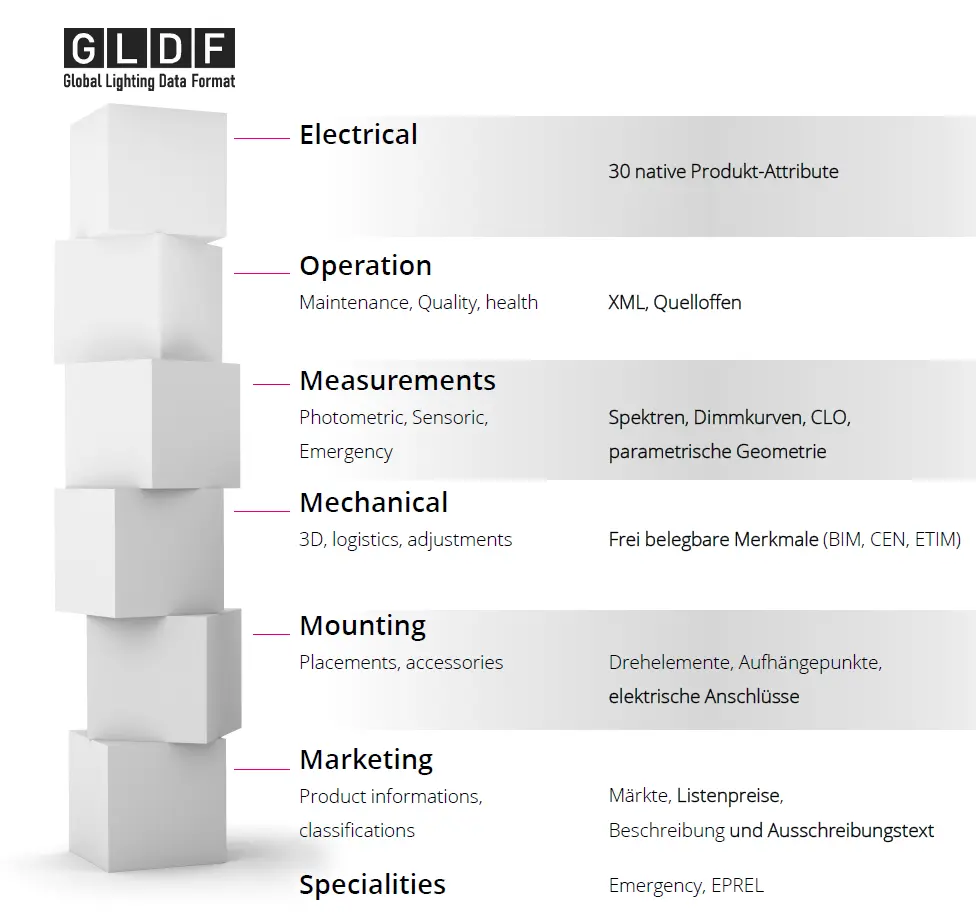
In the GLDF format, different attributes can be stored in categories
The RELUX and DIAL Partnership: How GLDF Came to Be
At the initiative of RELUX, the two companies DIAL and RELUX announced on 22 May 2019 their joint development of a new data format for luminaires and sensors: the Global Lighting Data Format (GLDF).
The starting point was frustrating for everyone involved:
- Luminaire manufacturers had to provide product information in numerous different formats – a new one for each use case.
- Planners and designers worked with multiple programs across diverse use cases and expected consistent product data in every tool.
- Software vendors needed complete and up-to-date information that existing formats could barely deliver.
The most widely used formats at the time – IES and LDT – were limited to photometric data. They could not capture geometry, textual product descriptions, product photos, or dynamic regulation and controllability. As digital planning methods like BIM gained ground, the demands placed on electronic product data grew far beyond what these formats could deliver.
The idea behind the RELUX and DIAL partnership: one open format which meets current and future needs – and is freely available to all.
In the joint announcement, both CEOs underlined the shared motivation. Markus Hegi, CEO & Partner of RELUX Informatik AG, focused on the data side: "Both manufacturers and users benefit from a great deal of added value" from a standardised, continuously maintained product data foundation. Dieter Polle, CEO of DIAL GmbH, framed it from a software perspective: "We want to make life easier for planners and manufacturers with DIALux".

Why RELUX and DIAL Decided to Cooperate – Despite Being Competitors
This is the question that came up most often in 2019: RELUX and DIALux are competing lighting planning programs. Why would they jointly develop a format that benefits both?
The answer was, and remains, pragmatic: RELUX and DIALux share customers. Luminaire manufacturers supplying product data to one platform almost always supply the other too. Lighting planners often use both programs depending on the project. Asking them to maintain two parallel data ecosystems wastes time and degrades quality on both sides.
Together, RELUX and DIALux cover the vast majority of the professional lighting planning global market. That market position creates a unique opportunity: by aligning on a single open format, the two companies can establish a de facto industry standard that moves digital planning forward – something neither could achieve alone.
Competition continues where it should: in software features, user experience, calculation engines, and services. But on the foundational layer of product data, cooperation creates more value than rivalry.
What RELUX and DIAL Solve with GLDF
GLDF is a container format built on XML. That makes it both human- and machine-readable, platform-independent, and widely supported. A single .gldf file can combine:
- Photometric and spectral data (light distribution curves, colour temperature, CRI)
- Geometric information (from simple cuboids to detailed 3D models in the L3D format)
- Electrotechnical data (power, voltage, control protocols)
- Commercial information (article numbers, prices, lead times)
- Maintenance and lifecycle data
- BIM characteristics according to CEN/TS 17623
- Dynamic regulation and controllability for tunable and connected luminaires
Geometry can be represented at three levels of detail: as a simple cuboid or cylinder, as a generic 3D model with defined dimensions, or as a realistic 3D model with textures and rotation angles. This means everything from a simple downlight to a complex, dimmable human-centric lighting installation with integrated motion sensor and emergency lighting can be described in a single file.
The proven ROLF (RELUX) and ULD (DIALux) company-specific formats remain fully supported, so manufacturers and planners have time to transition at their own pace. Strategically, however, GLDF is the path forward: new capabilities, deeper BIM integration, 3D detail through L3D, and adoption into international standards happen on GLDF, not on the legacy formats. Manufacturers who invest in GLDF today position themselves for the next decade of digital lighting planning.
GLDF Today: What RELUX and DIAL Jointly Provide
The 2019 commitment has grown into a productive ecosystem. RELUX and DIAL jointly maintain the format at GLDF.io, offering:
- Complete format documentation
- XSD schema definitions for developers
- Sample files and libraries for reading and writing
- Source code under MIT licence (free for private and commercial use)
- A feedback channel for community input
GLDF is natively integrated into both ReluxDesktop and DIALux. Manufacturers deliver a single file that works equally well in both environments – a major efficiency gain that significantly reduces the effort of maintaining product data. The format is also designed to be adopted unchanged into international BIM standards, which means the work done on GLDF carries directly into the broader CAD and BIM ecosystem (IFC, RFA).
GLDF Editor and GLDF Checker:
Free Tools from RELUX and DIAL
Two key tools support the day-to-day work with the format:
GLDF Editor – Manufacturers create and edit GLDF files directly, without needing deep XML expertise. Available at gldf.io/gldf-editor/.
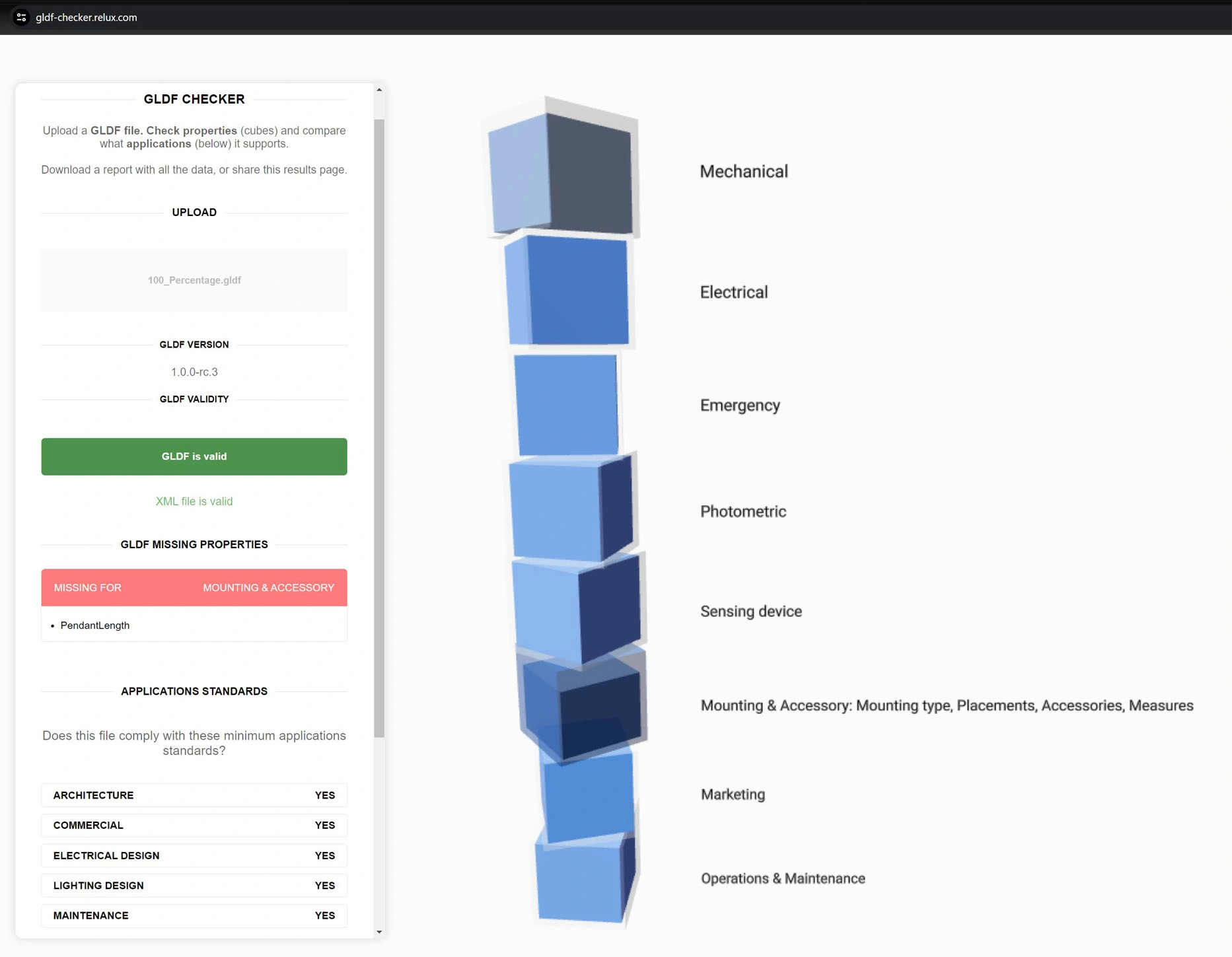
GLDF Checker – RELUX's free validation tool shows what data a GLDF file contains, how complete the native GLDF properties are, and which applications it can support. Available at gldf-checker.relux.com.
To round things off, RELUX provides a GLDF demo package with sample files covering a range of applications – free to download.
GLDF in Practice: FUN with RELUX on GLDF
To see the format in action, two episodes of the FUN with RELUX webinar series are particularly relevant:
- Episode 14 – Status of the GLDF format: An overview of the format's origin, its development status, and the strategic significance of the partnership with DIAL.
- Episode 51 – GLDF Tools: A hands-on walkthrough of the GLDF Editor, GLDF Checker, and how to integrate them into the lighting planning workflow.
Both episodes are available free of charge in English and German.
FAQ: About GLDF
No. GLDF is derivable from existing product data – manufacturers do not start from scratch. The data already maintained for RELUX and DIALux provides the foundation.
Both formats remain fully supported, so existing workflows continue to work. New capabilities, however, are being built on GLDF – including L3D 3D models, BIM property mapping, and integration into international standards. ULD and ROLF will continue to serve their purpose, but GLDF is the strategic direction for the years ahead.
Yes. GLDF is an open format. Any manufacturer can produce GLDF files. Each software vendor decides which data it imports from which manufacturer under which conditions.
RELUX and DIAL jointly own and steward the format. Both companies are explicitly committed to keeping it open and to supporting its transition into international standards.
GLDF is built on the work of international bodies including IESNA, ZVEI, ISO, UNI, and CIBSE. Current IFC or native RFA files can be derived from a GLDF dataset, and RELUX and DIAL actively participate in international BIM committees with the goal of having GLDF adopted into BIM standards largely unchanged.
Yes, in an advisory capacity. RELUX and DIAL lead the definition process and welcome input from knowledgeable market participants. Suggestions are reviewed and either integrated, deferred to future updates, or declined.
Yes. Format specifications, sample files, libraries for reading and writing including source code, and the reader and editor applications are all freely available to anyone interested.
Conclusion: GLDF Is More Than a Format – It Is an Industry Partnership
The RELUX and DIAL partnership demonstrates what is possible when two leading vendors put shared customer value above competitive instinct: an open, technically robust standard that benefits manufacturers, planners, and software developers alike. Anyone working in lighting planning, BIM, or product data management today cannot ignore GLDF – and benefits from the fact that it is precisely not the proprietary format of a single vendor.
Get Started with GLDF
→ Learn more on the official platform: GLDF.io
→ Discover GLDF tools and services at RELUX: relux.com/gldf
→ Validate your GLDF file with the free Checker: gldf-checker.relux.com
→ Watch the webinars: FUN with RELUX